Camino Francés
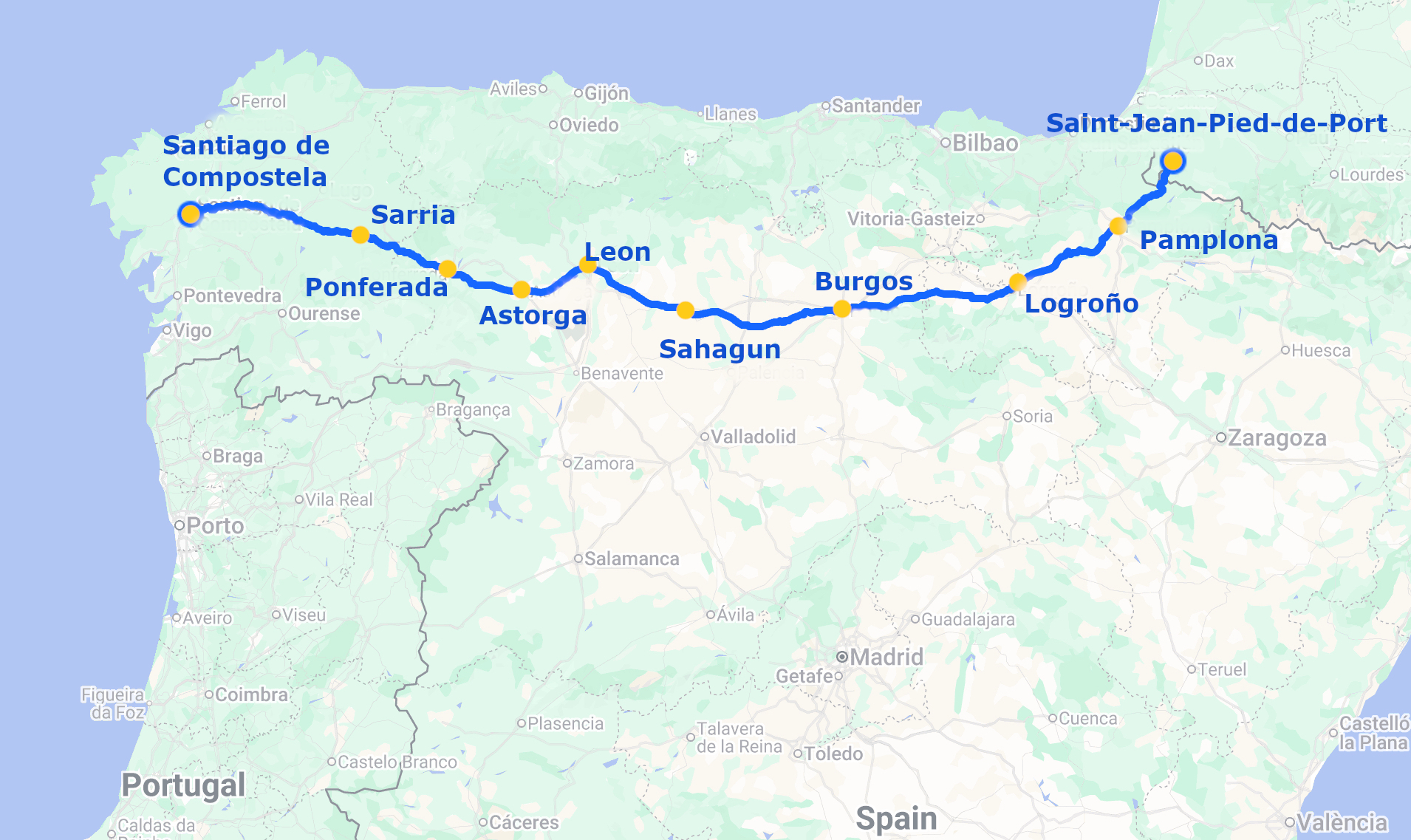
The most popular Camino route. Saint-Jean-Pied-de-Port to Santiago across the Pyrenees, the Meseta, and into Galicia.
Overview
The Camino Francés is the classic Camino, the one most people mean when they say “the Camino”. It’s the most walked route by far, taken by a large share of the pilgrims who arrive in Santiago each year. It runs about 790 km from Saint-Jean-Pied-de-Port in France to Santiago de Compostela, usually over roughly 33 stages of around 25 km, which most people complete in five weeks.
What makes the route special is the combination. It crosses two mountain ranges, traverses celebrated wine country, walks the long emptiness of the Meseta, then climbs into Galicia’s green hills before descending to the cathedral. The landscape changes almost weekly. The infrastructure is mature: there are albergues in nearly every village, restaurants that understand pilgrims, and centuries of foot-worn paths.
The route draws walkers of every kind: retirees, students on gap years, people in career transitions, families, and people walking in memory of someone. Most come alone, but few walk alone for long. By day three or four you recognise faces. By week three you’re exchanging contact details.
This isn’t an easy walk, but it’s achievable for anyone with moderate fitness and patience. The difficulty is endurance, not elevation or technical terrain.
Saint-Jean-Pied-de-Port
Saint-Jean-Pied-de-Port is a compact medieval town in the French Basque Country and the traditional starting point. Most pilgrims arrive a day early to sleep off jet lag, walk the short cobbled streets, and adjust to European time. The pilgrim office on the main street issues credencials and the latest advice on the Pyrenees crossing, and small shops sell or replace last-minute gear. There are albergues, guesthouses, and hotels, but beds fill fast in season, so book your first night ahead.
The Route
From Saint-Jean the route crosses the Pyrenees into Spain, rolls through Navarra and the vineyards of La Rioja, runs flat across the Meseta of Castilla y León, then climbs into the Galician mountains for the final descent to Santiago.
The Pyrenees: Saint-Jean to Pamplona
The first day is the route’s hardest, not for its distance but for its climb. Crossing the Pyrenees to Roncesvalles (about 25 km) gains roughly 1,200 metres, mostly on steep track, before a long descent. Many people walk it in a daze of jet lag and new-walker adrenaline. From Roncesvalles the route rolls through quiet Navarrese valleys and small towns: Zubiri with its medieval bridge, then on to Pamplona, the first real city, graceful and walkable, and famous for the Running of the Bulls in July. The old town is worth an afternoon.
Navarra and La Rioja: Pamplona to Logroño
After Pamplona the walking settles into gentle agricultural country. This is wine country, where vineyards slope down to small towns and the restaurants are genuinely good. Key stops include Puente la Reina, where routes from the Pyrenees converge at its famous bridge, the elegant medieval town of Estella, and Logroño, capital of La Rioja, whose Calle Laurel is renowned for tapas. The terrain is easy and the albergues busy enough that you’ll meet other pilgrims without trying.
The Meseta: Logroño to León
The Meseta is the famous middle: the long, flat, allegedly boring heart of the Camino, running across the high plateau of Castilla y León through wheat fields and under an enormous sky. It is genuinely flat and visually repetitive, shade is scarce, and the heat can be extreme in July and August. Key cities include Burgos, with one of Spain’s most important Gothic cathedrals, and León, where the mountains reappear. For many pilgrims the Meseta is the most meaningful stretch, the point where daily novelty stops mattering and the rhythm of walking becomes everything.
León to Astorga
After León the plateau ends and the terrain grows more dramatic as you move toward the mountains again. The route reaches Astorga, a small city on a hill with a striking Gaudí-designed palace and a pilgrimage tradition that predates the modern revival.
Galicia: Astorga to Santiago
From Astorga the landscape transforms. After weeks of wheat and sky you climb into green mountains, walking through forest into the cooler, often drizzly Atlantic climate. Villages become smaller and built of stone. The key moment is O Cebreiro, a mountain village of thatched stone pallozas at around 1,300 metres. From there it’s mostly descent through Galician forests to Sarria, the most popular 100 km starting point, and on through small villages until you round a bend and the cathedral appears.
The Meseta: Understanding the Middle
The Meseta deserves its own note, because it’s the part most people have heard about and the part that decides whether someone finds the Camino transformative or just tiring. It’s roughly 200 km of high, flat plateau between Burgos and León: endless wheat fields, occasional clusters of trees, and an enormous sky. On a hot July day with little shade it can feel like walking across a furnace.
But the Meseta is where the Camino stops being a hike and becomes a pilgrimage. There’s nowhere to hide from the monotony. No view distracts you and no technical challenge demands your focus. It’s you, your thoughts, your feet, and a straight path. Some pilgrims call it the Meseta’s gift; others find it bleak. Both are valid.
Practical tips: in summer, walk very early, before sunrise, to beat the heat, and carry extra water. Plan a rest day in Burgos. Splitting the longest plateau days into shorter ones isn’t failing, it’s adjusting to the terrain. Some people walk to podcasts or playlists; others prefer the silence.
Arriving in Santiago
After five weeks of walking, arriving in Santiago can feel anticlimactic, overwhelming, or transcendent, sometimes all three at once.
The Pilgrim’s Office (Oficina de Acogida al Peregrino) is on Rúa das Carretas, a short walk from the cathedral. To receive the Compostela you need at least two stamps a day over the final 100 km, one near the start of each stage and one near the end. It opens daily, roughly 09:00 to 19:00, and the queue is longest in summer, so go early morning or mid-afternoon. Staff speak English.
The Cathedral of Santiago de Compostela dominates the Plaza do Obradoiro. The pilgrim mass is celebrated at noon each day, with additional services in the morning and evening, and the names of recently arrived pilgrims are sometimes read aloud. Arrive early for a seat, especially in summer. Many pilgrims then walk on to Finisterre and Muxía on the coast; others rest in Santiago, which rewards a few days with its winding old town and good food.
Getting to Saint-Jean-Pied-de-Port
Saint-Jean is a small town off the main highways, so reaching it takes a little planning. The easiest single connection is the local train from Bayonne (about 1 hour 20 minutes); from Paris, take the TGV to Bayonne (around 4 hours) and change. From the Spanish side, there are seasonal buses from Pamplona, and year-round buses to nearby Roncesvalles. From Biarritz or San Sebastián, train connections exist but require transfers.
Best Time to Walk
April and May: spring brings wildflowers and greenery. April can still be wet and cool in the Pyrenees; May is warm, stable, and one of the busiest months.
June: warm and generally dry, avoiding the July–August crush. A good choice for relative solitude without winter risk.
July and August: the busiest season. Albergues fill by early afternoon in popular towns, and the Meseta can exceed 40°C. If you walk now, start early each day and plan rest days in larger towns.
September: many consider it the best month. Crowds thin, the weather stays warm, and the light is beautiful. Late September is ideal.
October: still good but increasingly wet, especially after mid-month. Albergues have space.
November to February: challenging. The Pyrenees may close with snow, many albergues shut, and the weather is cold and wet. For experienced winter walkers only.
Who Should Walk This Route?
The Francés suits first-time pilgrims who want company, infrastructure, and a clearly marked path. It suits anyone who wants the full arc of the Camino, from mountains to plateau to green Galicia, and has the five weeks to walk it. It suits walkers who want to fall easily into the social rhythm of shared albergue dinners. If you’re after solitude and quiet from day one, a shorter or less-travelled route may serve you better.
Practical Details
Daily cost: budget €35–50 a day. Albergue beds run €8–15, food €15–30 depending on whether you cook or eat out (a pilgrim’s menu is €12–15), and extras such as laundry and coffee €3–10. A tight budget on municipal albergues and supermarket food is possible at €25–30; a comfortable one with regular restaurant meals runs €50–60.
Credencial and stamps: buy your credencial before you start or in Saint-Jean (around €5). Collect at least two stamps a day over the final 100 km, from albergues, churches, town halls, cafés, and shops.
A typical day: the rhythm is shaped by the sun. Wake before sunrise, around 5 to 6 am, and be out the door as it comes up. Walk through the cool morning, stopping for a Spanish omelette and coffee rather than a long breakfast. At 4–5 km/h, 25 km takes six or seven hours, so you arrive between late morning and early afternoon, in time for the menú del día and a cold drink. The afternoon is for resting, exploring, and washing clothes. Dinner is communal or in a restaurant, and lights out is around 10 pm.
What to bring: pack minimally, 5–8 kg is standard. Bring broken-in walking shoes, moisture-wicking layers, a rain jacket, a lightweight sleeping liner, flip-flops for showers, basic toiletries, and a phone. Blister treatment, sunscreen, and good socks are non-negotiable, and you can buy almost anything else in any reasonably sized town.
Fitness: the Francés is accessible to most people with basic fitness, and the walking itself is the training. Having walked 10–20 km regularly beforehand helps prevent early injuries. People in their 70s and 80s walk the full route. It’s a test of consistency and patience, not extreme fitness.
After the Francés
Many pilgrims aren’t ready to stop at the cathedral and walk on to Finisterre and Muxía, around 90 km further, to finish at the Atlantic. Others rest in Santiago for a few days, explore Galicia, or head home. There’s no right way to end it.
Sources
- CaminoWays: Camino Francés route planner
- Follow the Camino: The ultimate guide to the full Camino Francés
- Pilgrim.es: French Way
- Stingy Nomads: Camino Francés walking stages 2026
- CaminoWays: Best time to walk the Camino
- CaminoWays: Cost of the Camino
- CaminoWays: How difficult is the Camino Francés
- Oficina del Peregrino: Pilgrim’s reception office
- American Pilgrims: How to get to Saint-Jean-Pied-de-Port
- Spain.info: French Way