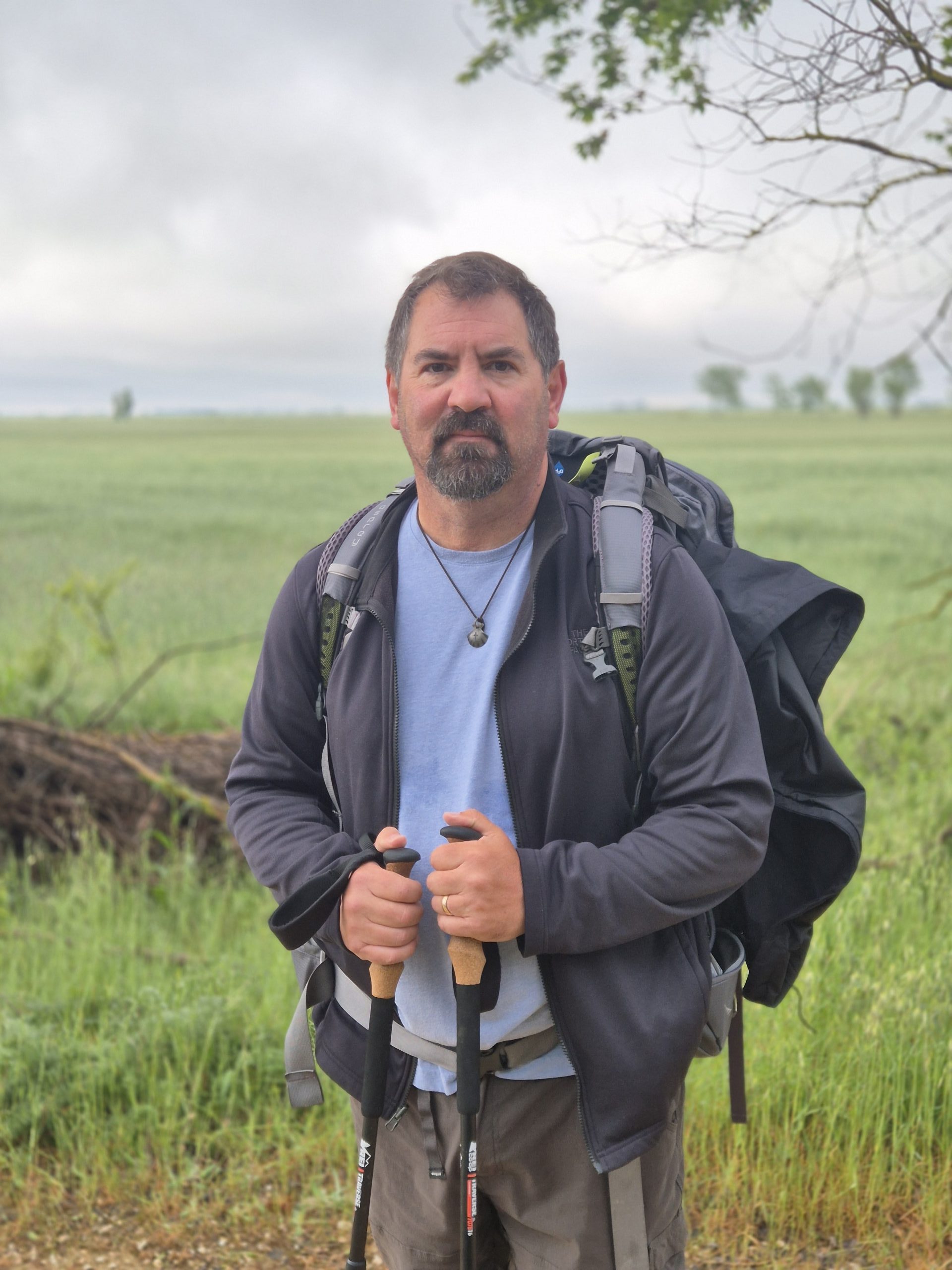
Brad from America
Maryland, USA
I met Brad on the Meseta, the long, flat stretch of the Camino Francés that tests the mind as much as the body. It was the third week of May, and the heat arrived early, draping itself over the golden plains like a heavy, invisible cloak. After leaving Carrión de los Condes, I joined a thin line of pilgrims spreading out across the horizon, the gravel path stretching ahead in a straight line as if drawn by hand. There were no towns, no fountains, and no shade for 17 kilometers—just the sun, the dust, and the sound of boots crunching over dry earth.
I rationed my water, careful to make it last, each sip measured against the remaining hours of walking. Seven kilometers in, salvation appeared in the form of a lone food truck parked by the trail. Under the shade of a tarp, a cluster of tables and chairs gave pilgrims a place to rest their legs and fill their bellies. I stopped for a glass of freshly squeezed orange juice and a simple tortilla, grateful for the small reprieve before pressing on. It was there, over breakfast and tired smiles exchanged with fellow walkers, that I met Brad.
Brad had walked the Camino once before, back in 2016, when he was younger and unencumbered. Back then, he carried no plan beyond putting one foot in front of the other, stopping when he was too tired to continue and laying his head wherever there was space. This time was different. Eight years later, Brad was walking the Camino with his wife, Tracy, and his approach had shifted. The spontaneity of his first Camino had given way to something more deliberate. The albergues were busier now—booked days in advance—and while municipal and donativo stops still operated on a first-come, first-served basis, Brad had taken no chances. Walking with Tracy meant ensuring a bed at the end of each day, a small bit of comfort for her on this unfamiliar journey.
As we talked, the contrast between the two Caminos became clear. For Brad, walking alone in 2016 had been an exercise in freedom, a chance to embrace life without structure or demands. This Camino was about sharing. He hoped that, away from their routines back in Maryland, the trail would offer Tracy the same perspective it had once given him. While Brad spoke with a quiet, assured calm, it was clear how much this mattered to him—not just the walking itself, but the opportunity to help Tracy step outside the life they had built together and see the world, and herself, differently.
By the time I rose to continue, the Meseta lay ahead unchanged, its monotony stretching far into the distance. Brad lingered under the food truck’s shade with Tracy, the two of them sharing a quiet moment before pressing on. I slung my pack over my shoulder and stepped back onto the trail, the crunch of gravel beneath my shoes the only sound as the sun climbed higher in the sky.
What motivated you to embark on the Camino de Santiago?
I first did the Camino in 2016, and I talked about it so much that my wife, Tracy, finally decided to join me. What’s really motivating me this time is to share the experience with her. I really enjoyed my first Camino—it meant a lot to me—and now we get to have this experience together. It’s something we can share, which is really nice.
Can you share a particularly memorable moment from your journey so far?
One of the most memorable moments has to be our first couple of days. They were horrible. We broke up the first two days with a stay at Orisson, and then walked to Roncesvalles the next day where it snowed. At Orisson, I thought I was being romantic by booking one of the only private rooms for my wife and me. It turned out to be a shed in the back, with no heat. It was 36 degrees Fahrenheit—about 2 degrees Celsius—and it was a rough night.
Looking back, though, it’s one of those memorable things you get through together. It’s the kind of moment that feels like an accomplishment once you’re on the other side.
What has been the biggest challenge you’ve faced on this journey, and how did you overcome it?
For me, it’s always foot issues. My body adjusts fine, but I have perpetual problems with my feet. They swell, which increases the chances of blisters. This time, I had a terrible blister on my heel. I’ve been walking for a week with a foot that felt like it was on fire every day, but I think I’ve finally got it resolved.
Last time, I had blisters the size of silver dollars on both heels and toes. I had to switch to hiking sandals because I couldn’t even get my boots back on. It was ugly, and I limped my way into Santiago. This time’s better, though.
I think the lesson for me is to take a long view of the Camino. If you get caught up in the day-to-day pain, frustrations, or inconveniences, it all starts to mount up. You have to remember it’s a long journey, and just like life, it’s going to have its ups and downs. Concentrate on the big picture. Be persistent. That’s the best advice I can give anyone struggling—don’t focus on the day, focus on the journey.
What is one thing you’ve learned about yourself while walking the Camino?
It’s the same lesson as last time: I can persevere. I can get through injury. It’s about prioritizing what you want in your mind. The Camino’s not easy for me physically—my feet always give me trouble—but I like it otherwise so much that I compartmentalize the pain. I tell myself, “This is just part of what I have to do to get through,” and it works itself out.
How has walking with your wife changed this experience for you?
It’s definitely a little different walking with Tracy. The first time I did the Camino, I didn’t worry about pre-booking anything. I’d just walk until I was tired and stop wherever I landed, even if it meant sleeping on the floor. I was okay with that.
This time, though, our needs are a little different. I want to make sure Tracy has somewhere comfortable to stay at the end of the day, so we’ve had to pre-book places. It changes the Camino a bit, but I’m okay with that.
I think Tracy needed this more than I did. I’ve created a good life for us back home, but she’s never done anything like this. It’s a little outside the box for her, and I think she needed to learn to let go of some things and live a little more carefree. She’s a much stronger walker than I am—usually, I’m the one chasing her! But for her, it’s been an adjustment to not have all the creature comforts or structure she’s used to.
It makes me happy to see her adjusting to it, though. This morning, maybe not so much, but otherwise, she’s doing great.
What advice would you give to someone preparing for the Camino?
Those of us walking the Camino know this already, but shoe selection is everything. It’s so important to know your feet. I know that my feet swell—probably about a full size—so I have to make sure my shoes are too big. I wear extra socks and then take those layers off as I go to accommodate for the swelling.
Blisters come when your feet swell and change size inside the shoe, so it’s all about managing that. Gear-wise, the most important thing you’ll pick is your shoes. You and I have the same shoes, the HOKAs, which are great because of the extra cushion. When you’re 230 pounds like me, that extra cushion makes a huge difference. It’s a lot of pounding on your feet.
At the end of the day, it’s all about the shoes, baby.
What’s been the most unexpected or funniest thing that has happened so far?
I think one of the funniest moments was probably that stay in Orisson—it wasn’t funny at the time, but it sure is now. I was trying to do something nice, thinking I’d booked a romantic room, and it turned out to be a freezing shed with no heat. We laugh about it now, but that night, it was miserable.
It’s those little moments, though—when things don’t go perfectly—that become the stories you tell and laugh about later.