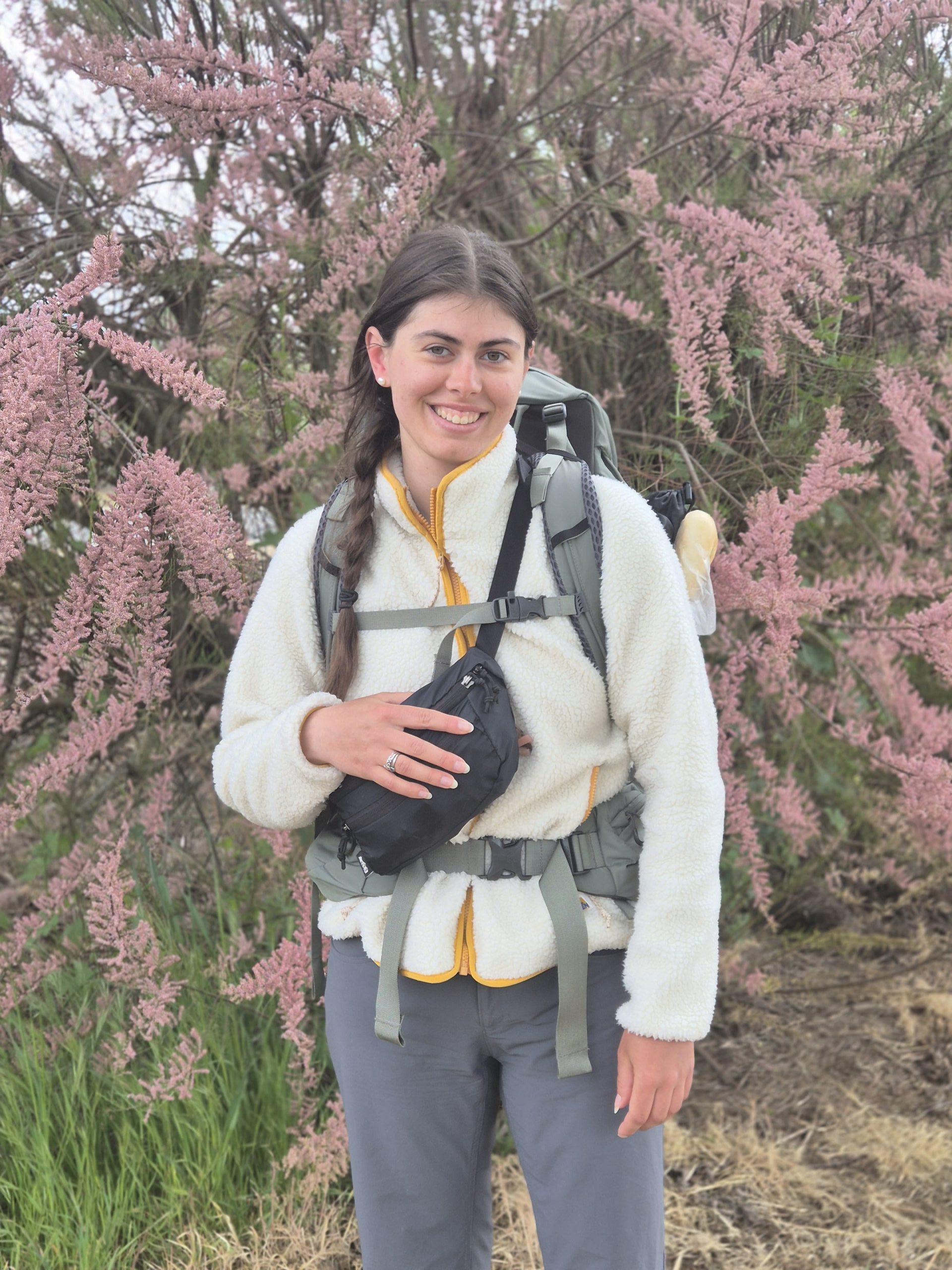
Caecilia from America
Minnesota, USA
There’s something very communal about the Camino. Everyone, on some level, is experiencing the same thing, and that in itself is motivating. There’s a compassion and empathy that comes from it, too.
Hontanas, tucked away in a shallow dip of the Meseta, seemed to appear out of nowhere after hours of walking through endless farmland. Its red-tiled roofs and stone buildings came into view suddenly, offering weary pilgrims the promise of rest. The streets were quiet and narrow, winding gently toward a central church with a bell tower that seemed to keep watch over the village. By the time I arrived, the sun was high, and the chill of the early morning had long since given way to the heat of the day.
I had covered 32 kilometers that day, setting out from Burgos before dawn. The path had taken me through open plains, undulating hills, and a stretch of windmills turning lazily in the breeze. I arrived in Hontanas stiff and sore, the weeks of wear and tear on my body beginning to take their toll. I checked into a small dorm at the far end of the albergue and, after unloading my pack, indulged in a beer at the bar below, followed by a swim and sauna at the town’s modest pool. It was a small luxury—a bit of a splurge for anyone on a budget—but the peace and solitude made it worth it. I was the only person there, soaking in the quiet and letting the warmth of the sauna work through the soreness in my legs.
Lunch and laundry came next, and by mid-afternoon, my clothes were drying on a line as the rhythm of the Camino settled into its familiar cadence of arrival, rest, and preparation for the next day.
The evening brought the town’s procession, a tradition that drew both locals and pilgrims into the narrow streets. The ritual began with the copper processional cross from the 13th century, carried aloft at the front, followed by a large red flag rippling in the breeze. The voices of the choir rose out from the church, their chanting carrying through the cobblestone lanes as candles flickered in the twilight. It felt sacred, timeless—a moment where the ancient practice of pilgrimage merged with the spiritual traditions of this small village.
As a Lutheran, I found myself moved by the deep Catholic roots of the Camino. There was a reverence here, a tangible connection to centuries of faith and devotion. I stood in the procession, watching the light of the candles dance across weathered stone walls, and felt something stir inside me—a reminder that this journey was about more than just the miles walked.
Later that evening, I sat with Jonatán, a Spanish pilgrim, in the albergue’s common area. We talked long into the night, our conversation ranging from the physical demands of the Camino to the philosophical questions that arise when you spend weeks walking and reflecting. He shared his own spiritual journey, his struggles with faith, and his hopes for what this pilgrimage might bring him. In return, I opened up about my own journey—how I had felt lost for a long time, unsure of my direction and purpose.
“The Camino has a way of showing you what you need to see,” Jonatán said quietly, sipping his wine.
I thought about that as I lay in my bunk later, listening to the gentle snores of the other pilgrims in the dark. He was right, in a way. The Camino wasn’t just a physical journey; it was a spiritual and emotional reckoning.
What motivated you to embark on the Camino de Santiago?
I wanted to take time away and process things in my life. I had just graduated from university, and I was in a transition phase. I needed to reset and figure out what comes next. A friend of mine had walked the Camino about two years ago, and she talked about how transformative it was. I thought, “Why not?” So I booked the flights and here I am.
Can you share a particularly memorable moment from your journey so far?
One of the most memorable moments was a night I had with my three Camino friends—Jonatán, Marta, and Alex. We were sitting on the steps in front of a church, watching the sunset over the Meseta. The light was golden, and everything was so still. We were all quiet, just sitting together. I remember thinking, “This is exactly what I needed.” Not talking, just being present with these people who have become like family to me over the past few weeks. It was one of those moments where you feel completely alive and grateful for where you are.
What has been the biggest challenge you’ve faced on this journey, and how did you overcome it?
The physical pain has been difficult. My feet, my knees, my back—there are days when everything hurts. But I think the bigger challenge has been the mental one. There are moments when doubt creeps in: “Why am I doing this? What am I trying to prove?” On those days, I lean on my Camino community. My friends remind me why I’m here, and we push through together. I’ve also learned to listen to my body and take rest days when I need them. There’s no shame in slowing down.
Can you share any Camino wisdom?
The biggest thing I’ve learned is that the Camino isn’t a race. I spent the first week trying to keep up with everyone and cover as many kilometers as possible. But once I slowed down and started walking my own pace, everything changed. I started noticing things—the way the light hits the fields, the kindness of strangers, the strength I didn’t know I had. There’s a reason it’s called a pilgrimage and not a hike. The point is the journey, not the destination.
What is one thing you’ve learned about yourself while walking the Camino?
I’ve learned that I’m stronger than I thought I was. Not just physically, though that’s true too. I’ve learned that I can sit with discomfort—physical pain, emotional pain, uncertainty—and still keep going. I’ve also realized how much I need community. I’m someone who can be quite introverted, and I thought I’d do this walk alone and be fine with it. But the connections I’ve made here have been everything. The shared suffering, the shared joy—it’s bonded us in a way that I didn’t expect.
I’ve also been reminded of the importance of faith. Sometimes I think I’d forgotten that.
The last three or four years, since I got out of university, I struggled with my faith. It was rough. I still believed in God, but it wasn’t really a part of my day-to-day life. Now, I think I’m finding a way to let it be more present every day. It’s been a lot of internal wrestling, but I feel like I’m growing through it.
What’s the funniest or most unexpected thing that has happened to you on the Camino?
The funniest moment was the other day. We were all having a bit of a rough day, walking at our own pace, when suddenly I heard someone running. The last person I ever expected to see sprinting past me at full speed was Jonatán. It caught me so off guard, I just started laughing.
It was such a break from the normal routine. I was in a lot of pain that day, and it was very much a mental game for me. Jonatán had put some music on to push through the last two kilometers, and it just lifted the mood and gave us all a little bit of motivation.