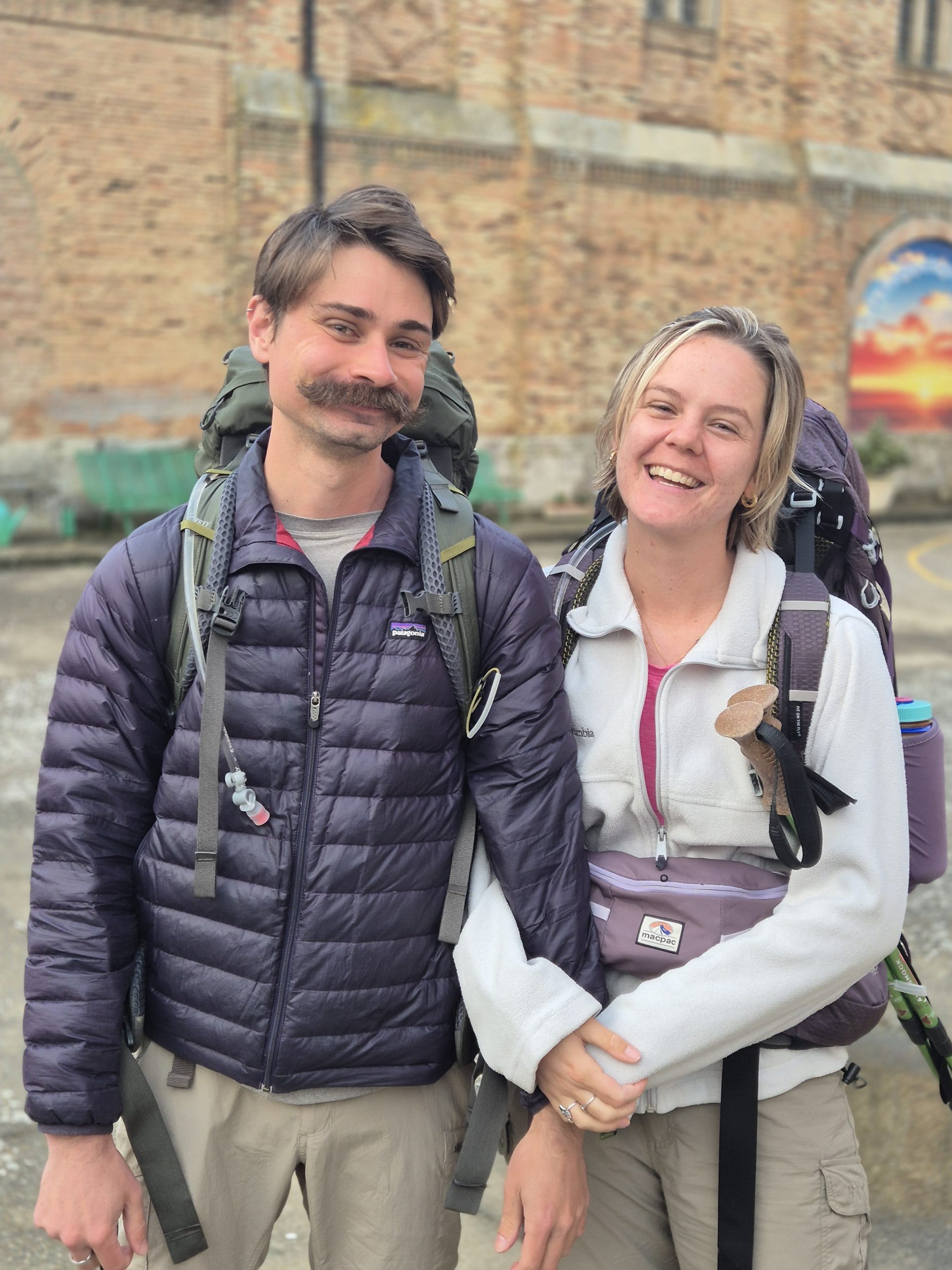
I first met Kayla and Dan in the lively town of Santo Domingo de la Calzada, known for its deep ties to Camino history and the legend of the Miracle of the Hen. We were sharing a dorm room with thirteen other pilgrims, part of a sprawling albergue that seemed almost endless. The building had at least one more floor of similar dorms, all connected by a shared kitchen, dining room, and common area on the top level. It was one of the largest albergues on the Camino Frances—a hub for travelers converging on the town.
I’d arrived in Santo Domingo after an early start from Najera, leaving just as the first light broke over the horizon. The morning felt like a race against my own shadow, which I finally overtook upon entering the town. The albergue itself, the Casa de la Cofradía del Santo—or House of the Brotherhood of the Saint—was situated right on the main square. As I checked in, I found myself surrounded by the vibrancy of the town’s annual festival. A procession of girls in white, bridal-like dresses carried ornate baskets on their heads, accompanied by an ox-drawn cart and a throng of townsfolk, all making their way into the grand church. The spectacle seemed to center around the square, just steps from the albergue entrance.
After settling into the dorm and leaving my things, I ventured back to the streets, still hot and tired from the morning’s walk. I grabbed a large glass of the local Estrella beer and searched for a place to sit. All the tables were occupied by other pilgrims, their exhaustion melting into the foam of their drinks, each gasp of life a rush of bubbles hitting parched throats. Just as I was resigning myself to standing—beer in hand and ache in feet—I was offered a seat by an Australian couple, Kayla and Dan. I gladly accepted, and from that moment, we stuck together for most of the day and many more to come.
Days later, in the town of Carrión de los Condes, it was Kayla and Dan who invited me to join their table once again, this time to share a meal with a Danish couple they’d met. It was during that meal, as we shared stories and laughter, that the idea struck me to interview pilgrims along the road. Something about the conversations we’d been having—honest and open—made me want to capture that spark, to hold onto the intangible energy that drives us all toward Santiago.
The following morning, I was roused from sleep by the group of older Italian men sharing my room, chief among them Bruno, and the spark of action hit me—I held my first interview. That same morning, while preparing to set off for the day, I spotted Benedetta, an Italian girl from Sardinia whom I had crossed paths with before, traveling with a large group of young Italian men. She became my second interview. And as I was about to leave, I saw Kayla and Dan—the third interview being the charm.
Kayla and Dan were familiar faces throughout my Camino journey, and every time we crossed paths, their presence made the day a little brighter. By chance, we ended up entering Santiago on the same day, our feet a patchwork of blisters old and new, and stood before the Compostela, both weary and elated. It was with them that I attended the pilgrim mass at the end of the Camino Frances and later stood on the rocks at Finisterre, ‘the edge of the world,’ watching the sun sink into the horizon and signal the end of our westward journey.
These moments of shared triumph and reflection felt like a fitting conclusion to the bond we had first formed back in Santo Domingo.
What motivated you to embark on the Camino de Santiago?
Honestly, because Dan mentioned it to me. He said he’d wanted to do it for a long time, and yeah, I like being outdoors. It just seemed like a good challenge and an excuse to spend literally a month outside, doing our own thing. That’s kind of it.
Can you share a particularly memorable moment from your journey so far?
Most of the memorable moments have been about the people we’ve met. Just getting to meet people from so many different backgrounds, learning about their experiences, and also finding all the things we have in common.
The things I’ve enjoyed most have been cooking, sharing meals, and playing games with people. And of course, the scenery—it’s been amazing as well.
What has been the biggest challenge you’ve faced on this journey, and how did you overcome it?
The biggest challenge has been pain. I have a chronic pain condition, so on the bigger or faster days—like yesterday—it can be really hard to keep going.
What’s helped is talking to other people or just repeating a mantra in my head over and over until I get to a point where it feels more manageable.
What is something you’ve learned about yourself while walking the Camino?
That I’m a lot more resilient than I give myself credit for. A lot of the time, I think the mind is so powerful—it’s stronger than we realize.
I’ve also learned that it’s okay, and even good, to be proud of yourself.
Can you share any Camino wisdom?
The thing we’ve kept saying is that there’s no one way to do the Camino—just like there’s no one way to live your life.
This journey has felt so judgment-free, and it’s made me, and I think us, feel more at ease and free. Hopefully, going back to our daily lives, we can carry that with us—realizing that, at the end of the day, it doesn’t really matter. Everyone’s on their own journey, and there’s no “right” way to do things.
How do you think this experience will influence your life after the Camino?
It’s given me more confidence that I’m on the right path. Going back to what I said before—there’s no one way to do things.
I think this has helped me let go of the fear of trying new things or the idea that I’m too old to do something. That mentality is so common, and I’ve felt it myself since I was a teenager—thinking I can’t do this or that.
But seeing people of all ages and backgrounds doing the Camino has reminded me that I can do whatever I want.