Introduction
I had no accommodation reserved in El Burgo Ranero. It was 13 kilometers from Sahagún, where I’d set out that morning after a two-day rest due to acute tendonitis in my right shin, just above the ankle. I left with my ankle still partially immobilized, relying on walking poles to keep the weight off, and used a bag forwarding service to send my main pack ahead. Instead, I carried a light daypack with just the essentials.
Most pilgrims stop in Sahagún, the halfway point on the Camino Francés and a reasonably large town. Others, however, stop 13 kilometers earlier in Terradillos de los Templarios, a tiny hamlet with two albergues named after the Knights Templar. It was in Terradillos that I first limped in, my tendonitis making itself painfully known. From there, I took a cab to Sahagún to visit a clinic and see a doctor. After two nights of rest in Sahagún, I resumed walking and set out for El Burgo Ranero, 13 kilometers further along the Camino. By the time I began looking for accommodation in El Burgo Ranero, it seemed every available bed had been booked, as my WhatsApp messages to the local albergues were met with the same reply: “Lo siento”—“I’m sorry.”
Fortunately, the municipal albergues and donativos, run by religious orders or volunteers, do not accept bookings. It’s first come, first served. Setting off early, I pushed as hard as my foot would allow, gaining some false courage from the easy availability of prescription-strength painkillers at Spanish pharmacies.
I arrived around midday, falling somewhere in the middle of the pack—early enough to secure a bed but late enough to wait in the hot sun while others checked in. Donativos subsist on donations from pilgrims and whatever support the volunteer organizations can muster. Pilgrims are encouraged to donate as they would for a standard albergue, rather than treating them as free services.
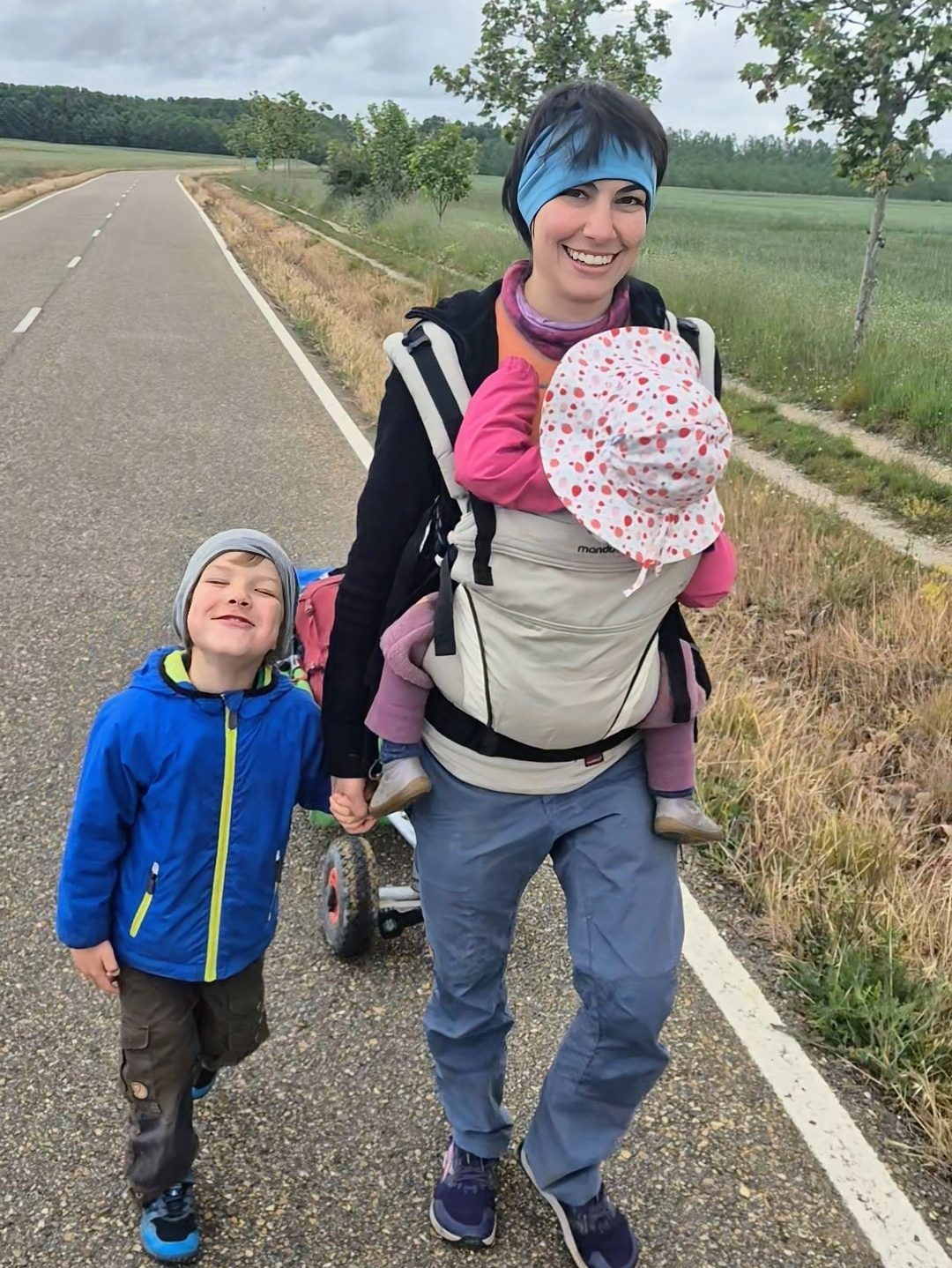
Sitting on a bench outside the albergue, waiting for it to open, I noticed a young German woman resting after the long day’s walk. She seemed preoccupied with two children—her young son, perhaps in junior school, and a little girl, in the throes of teething. It wasn’t the first time I’d seen them, though it was the first time I realized they were pilgrims.
A few days earlier, in Carrión de los Condes, I had been sitting with a group of pilgrims—some I knew, others I was meeting for the first time—when we saw Olivia passing by with her children in tow. As they walked past, we gave out a cheer and clapped, to which mother and eldest smiled with embarrassment, while the youngest, caught up in the excitement, joined in clapping as best she could.
Sitting outside the volunteer-run donativo, Olivia’s eldest, Julius, began edging closer to the walking poles I’d left resting on the bench. He knew I could see him, but the boundless courage of childhood won out. No sooner had he picked them up than his mother told him to leave them alone. I quickly interjected, saying it was fine, and took back one pole to engage him in an impromptu sword fight. I extended mine slightly for an advantage, which he didn’t appreciate since he couldn’t figure out how to extend his own. His sister, Lydia, soon decided to join the fray, throwing herself into the action and gleefully breaking up our duel.
As we waited for the donativo to open, our bags lined up at the door to hold our place in line, I spent some time chatting with Olivia. I asked if she might be willing to do an interview later in the day, and she agreed, provided her children were settled. At that moment, though, everyone’s priority was getting a bed and grabbing some much-needed rest.
Later, after the afternoon naps had restored everyone’s energy, I reconnected with Olivia and the kids as she planned dinner. I offered to cook for all of us—a simple one-pot meal I often made for myself on the trail: fusilli pasta with sauce, local ham, and chorizo. It was an easy solution to share the food I couldn’t finish alone and avoid carrying leftovers. She accepted, and we agreed to do the interview after dinner, once the kids were fed and settled.
Another pilgrim joined us at our table, an older woman who kindly offered to share some of her food. Olivia and Julius sampled from both meals, while Lydia stuck to her own, still lacking the teeth to tackle pasta and the other ingredients. Julius seemed to enjoy my cooking, eagerly helping himself to a second portion. After dinner, the kids played in the albergue—Julius exploring its confines like a medieval castle and Lydia toddling after her big brother, utterly fascinated.
The albergue, filled mostly with older pilgrims and volunteers, seemed to light up with the children’s presence. Smiles greeted Julius and Lydia wherever they went, their laughter bringing joy to the quiet evening.
The next morning, we set off walking together. The kids were full of energy—Julius pulling faces whenever I tried to take a photo and Lydia alternating between being carried by her mother and riding in the canvas trailer that held their bags and supplies.
What inspired you to take this journey with your children?
Actually, I saw a documentary about a woman cycling—I don’t know which city—let’s say Munich to Istanbul with her 5-year-old son, and then I had the idea that I could do something similar. Once the idea was born, it wouldn’t go away. I chose the Camino because it has so many accommodations along the way, so we could do shorter stages, which would be suitable for the kids.
What are some of the challenges you’ve faced on the Camino with young children?
I would say keeping the children motivated and happy. Sometimes my son gets tired, and my daughter is teething at the moment, so she’s unhappy. That’s a challenge because I always have to be present, motivate them, or pay attention. The other challenge is making sure they’re quiet at night when other people are sleeping—it’s hard to ensure my baby doesn’t cry at night.
Can you share a memorable moment or story from your journey with your children so far?
What stands out is when we slept in a church that had no electricity. At night, there were only candles, and for my son, it was so special. He told everyone, “We slept in a church with candles like it was 100 years ago.” That was a really memorable experience for us.
How do you think this experience is impacting your children?
I think my son has gained confidence. Before, he was very shy in new environments, especially when he didn’t know what was expected of him. Here, he’s become more open—he speaks to other people he doesn’t know and interacts with them. He’s also boosted by everyone telling him how strong he is and how far he’s walked. It’s really nice to see him grow.
What activities or routines have you found helpful to keep your children engaged and happy on the trail?
For my little one, Lydia, I give her food—something she can hold in her hand and eat while she’s in the carriage. For my son, Julius, I engage him in conversation, listen to his stories, or tell him my own. Most of the time, though, we’re just walking and going with the flow.
What has surprised you the most about traveling the Camino with your family?
I was surprised at how smoothly everything has gone. When we first came, I told everyone, “We’ll try it, and if it doesn’t work out, we’ll just do a beach holiday and fly home.” That was my backup plan. But we’ve found our routines—waking up, packing our bags, walking, and arriving just after lunch. The kids nap, and then we have the afternoons free to explore. It’s been much easier than I expected.
What advice would you give to other parents thinking about undertaking a similar journey with their kids?
Just try it! It depends on the age of the children, of course, but if you find the right time, everything can work out perfectly. And bring a potty. People might say it’s impossible or crazy, but you’ll never know unless you try.
What have been your favorite parts of the day on the Camino? What are your children’s favorite parts?
I enjoy every part—waking up, walking, arriving at the albergue, and dinner in the evening. The only time I don’t enjoy is when my son has a rough patch—maybe he’s hungry or in a bad mood for half an hour. But apart from that, I love the whole day. For my son, he loves arriving somewhere new, especially when there’s something unique like the church with candles.
If you could do this journey again, what would you do differently?
I’d pack more food. At the beginning, I assumed every village would have a supermarket, but some didn’t. We had days where we ate bread with almonds because there was no cheese or anything else for lunch. Once I realized that, I started carrying snacks, and it made a big difference. Other than that, I wouldn’t change much.
How do you balance the physical demands of the walk with the needs and limits of your children?
It hasn’t been too hard. I’ve had a couple of days with foot pain, but the bigger challenge is keeping everyone motivated—especially my son. That’s more demanding than the physical part.
What has been the most challenging aspect of managing your personal needs against the demands of your children on the trail?
Showering is the hardest. My daughter won’t stay with anyone else, so I can only shower when both kids are asleep. I have to shower quickly in the morning before they wake up, which is always a bit stressful because there’s a risk of her waking up crying.
What personal goals did you set for yourself on this journey?
Maybe my personal goal is just to be a good mom every day.
Have there been moments on the journey when you felt particularly proud of yourself?
I don’t think I’ve felt proud of myself, but I felt proud of my son yesterday. We walked 17 kilometers, and he was in such a good mood—jumping, skipping, and happy the whole way. At the end, when his feet hurt, I offered him the carriage, but he refused and finished on his own. That was a proud moment for me.
How do you balance the roles of guide and participant while walking with your children?
This is my first time walking the Camino, and I’m doing it with kids, so this is my Camino experience. I know I’m missing out on communal dinners, sharing sessions, or sitting with others over wine, but we’re creating our own experiences, and that’s fine with me.
What are your go-to and essential items that you bring with you? What did you bring that have never seen the light of day?
The cart is essential because my kids can sit in it, and rain gear is crucial. For my little one, I use cloth diapers, and that’s been essential for us. As for things I haven’t used, the umbrella hasn’t been necessary yet, but I’m keeping it just in case we need shade one day. I also brought a lock for the trolley but haven’t used it.
Is there anything you’ve learned on the Camino that you will carry back into regular life?
Caring for children is always challenging, and I’m learning and trying to do my best every day. The lessons and challenges here aren’t so different from those at home, and I’ll carry them back with me.