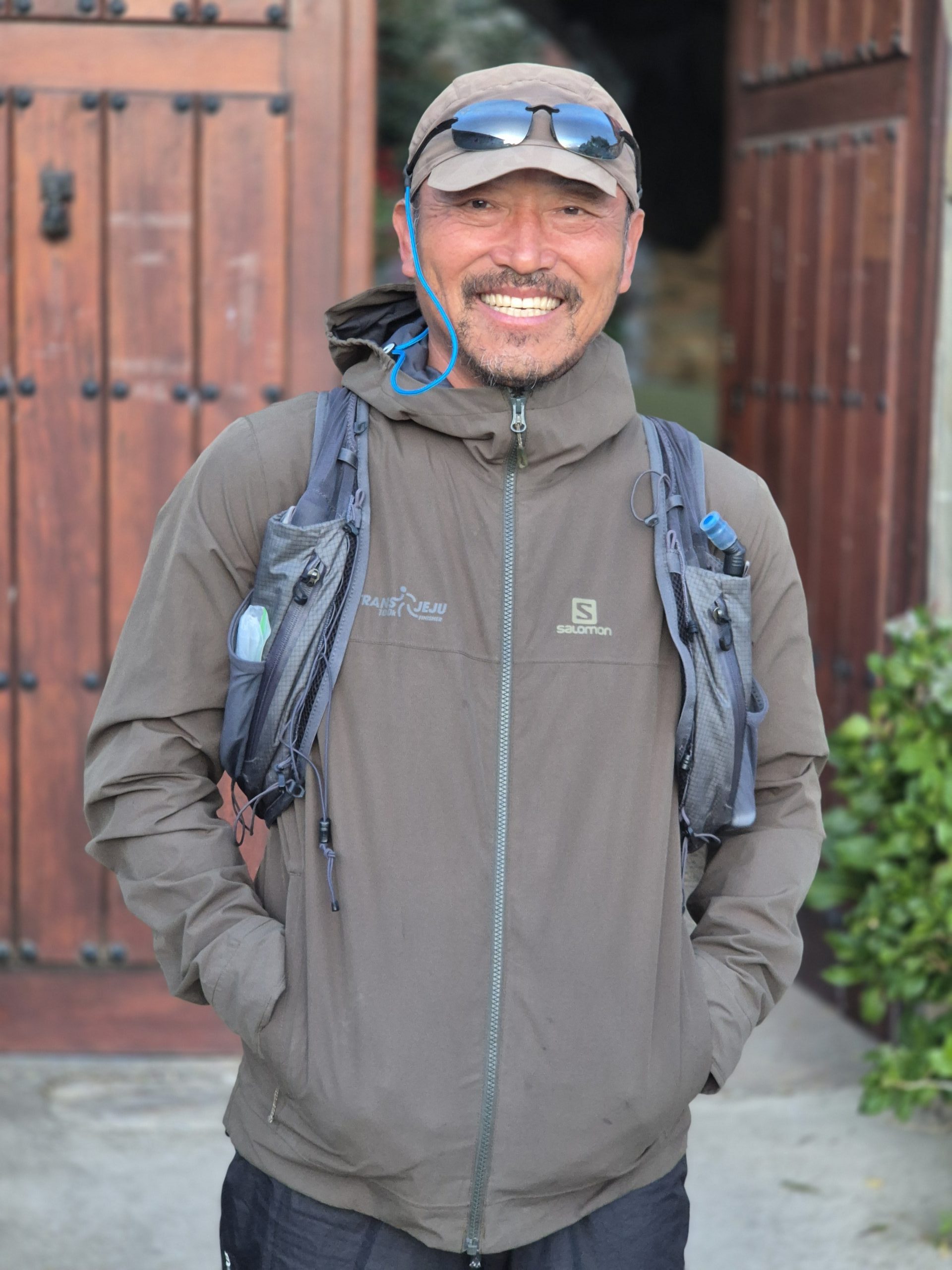
Interview translated from Korean. The original text has also been included for context. Apologies for any errors in translation.
I met Hong Young Pyo in Rabanal del Camino, a small mountain town of just 60 residents nestled at the foot of Mount Irago. Its Romanesque stone buildings blended seamlessly with the rugged landscape, offering a natural and quiet pause on the climb to the highest point of the Camino Francés.
The journey from Astorga had been a steady ascent through quiet roads and small villages, flanked by forests alive with the traces of those who had walked before. At one point, the path veered into the woods, where a long fence adorned with twig crosses marked the passage of countless pilgrims. Arriving in Rabanal, I’d considered pressing on to Foncebadón, but the looming incline and a hint of rain made the town’s stillness and simplicity an easy choice for rest.
I chose Albergue Nuestra Señora del Pilar for the night, drawn to its imposing yet secluded façade. The building’s arched doorway, framed by two heavy wooden doors, led into a covered archway that opened onto a narrow courtyard. Plastic tables and chairs filled the communal space, shaded by umbrellas at midday while the surrounding buildings cast long shadows in the morning and late afternoon. After checking in, I washed my clothes to dry in the sun and sat down with a beer.
Not long after, I was joined by familiar faces: Georgie and Nick, a British couple I’d shared accommodation with before, and Choi Way and Heesoo Kim, two Korean pilgrims traveling together after meeting along the route. We spent a couple of hours socializing, chasing the last patches of sunlight across the courtyard as the afternoon waned and the shadows grew. It was during this time that Hong Young Pyo arrived. Taking the last available bed, he settled in quietly, sitting alone in the restaurant area.
Eager to conduct another interview, I began with Georgie and Nick, though Georgie did most of the talking. I then asked Choi Way if she’d be interested in an interview, but she declined, instead suggesting I speak with the new arrival. With her help and the use of a speech-to-text recording app in Korean, I approached Hong Young Pyo, who graciously agreed.
Before we began, he shared some background on his Camino experience. Unlike most pilgrims who walked 20–30 kilometers a day, Young Pyo was covering an impressive 50 kilometers daily—12 to 13 hours of walking from sunrise to late evening. His pace was remarkable, rivaled only by a young English university graduate I’d met earlier, who was running the Camino in marathon-length stages to celebrate his graduation.
What motivated you to embark on the Camino de Santiago?
It felt like a natural flow in my life.
자연적인 흐름
Can you share a particularly memorable moment from your journey so far?
Making choices is always difficult because there are so many options. But overall, I think of it as entering a universal realm of harmony.
선택을 한다는 거는 어렵지요 너무 많은 거니까 하지만 다 통틀어서 공의 세계 영 (Making a choice is difficult because there are too many, but overall, the world of emptiness is the spirit of emptiness.)
What has been the biggest challenge you’ve faced on this journey, and how did you overcome it?
I’m quite different from others in many ways. I dislike laziness, so I stay focused on what I do. When I finish one task, I let my imagination take over and think of the next step. That imagination has helped me avoid feeling like anything was truly difficult.
나는 다른 사람하고 많은 차이점이 있는데 일단은 게으름을 싫어하기 때문에 내가 하는 일이든 또 그게 이제 끝나면 또 다른 상상을 많이 하기 때문에 그 상상을 통해서 모든 어려움은 없었다.
Can you share any Camino wisdom?
Wisdom reveals itself to those who are not lazy.
게으르지 않으면 지혜는 다 보입니다
What is one thing you’ve learned about yourself while walking the Camino?
In Confucian culture, there are clear distinctions between the roles of men and women. Initially, it was hard for me to do tasks traditionally considered ‘women’s work.’ But as I adapted, I began to empathize with my wife’s perspective, and now I don’t see it as a big deal.
그 유교적인 문화에서는 여자하고 남자 할 일이 구분돼 있잖아 근데 여자가 했던 일을 내가 해야 되니까 처음엔 되게 힘들었지만 수능하면서 아내 입장을 느끼게 됐지 그걸 되게 크게 생각하지
How do you think this experience will influence your life after the Camino?
I didn’t come to the Camino with a specific purpose, so I don’t expect to gain anything specific either. But if I feel the instinct to return, I’ll come again naturally. Just as there are 12 months in a year, I’d like to come 12 more times in my life.
여기를 까미노로 온게 목적을 위해서 온게 아니기 때문에 반대로 얻는 것도 필요 없고 바라지도 않고 또 다음에도 느끼는 대로 본능적으로 오고 싶으면 언제든지 오고 싶은데 1년에 12달이 있듯이 12번 만큼은 오고 싶다
Is there someone you’ve met on the trail who has impacted your journey? Can you tell me about them?
When I first came in the winter of 2020, I met a 74-year-old German man who was on his 24th Camino. He inspired me deeply, and because of him, I think I’ll keep coming back often.
2020년 겨울 처음에 땀이나 왔을 때 독일 74세 된 형님 24번째 오신다고 그분을 보고 영감을 얻어서 오게 됐지요 자주 올 것 같습니다
What is the most essential item you’ve carried with you, and why is it so important?
Everything I carry is important, but there are some items I haven’t even touched yet, like one of my three pairs of socks, one of my three T-shirts, and a pair of long tights. For things I don’t use, I prefer to discard them to lighten the load.
다 소중한데 아직까지 만져 보지 못했던 그 쓰지 않았던 몇 개가 있는데 양말 세 개 중에 하나 그다음에 티셔츠 세 개 중에 하나 그다음에롱 타이즈요 필요 없는 세계에는 먼저 버리고 싶다고
Would you recommend the Camino de Santiago to others, and what advice would you give to someone who’s considering it?
I wish everyone could come here, but most people can’t due to the demands of daily life. For those who need courage, I always recommend the Camino. You need courage to embark on this journey.
그 누구나 여기를 와 봤으면 좋겠는데 대부분 사람들은 못 오지요 현실적인 그 생활 때문에 용기가 필요한 사람들이 보이면 그분들한테는 늘 여기 오기를 권합니다 용기가 있어야 됩니다
How do you think walking the Camino in 2024 is different from what it might have been like years ago?
I’ve come in late winter, early winter, and summer before, but now it’s spring. Comparing seasons feels meaningless to me; each time is unique.
그 전에는 겨울 초겨울 늦게 올 한 번씩 그 다음에 만 여름에 한번 왔기 때문에 지금은 봄이기 때문에 비교한다는 거는 넌센스라고 생각합니다
What part of the day on the Camino do you find most challenging or rewarding?
Crossing the Pyrenees was the most emotional moment for me. I cried a lot, not just because it was tough for me, but also seeing an elderly couple and people who were visibly struggling. Their perseverance moved me deeply.
그 니트에서 왔기 때문에 루피의 끝나는 지점이 그 비례네 산맥 그 산을 넘어서 눈물이 많이 흘렸는데 물론 나도 힘들었지만 그 노부부 또 이렇게 이렇게 살찐 살찐 분들이 걷는 그 힘든 모습을 보면서 눈물을 많이 흘렸다고 피레네 산맥을 넘을 때가 제일 감동적이었고 눈물이났다
Have you discovered any new beliefs or changed any old ones during your walk?
I’ve met so many people who bring light into the world. They’ve inspired me to think more deeply about contributing to creating a brighter world myself.
그 세상을 밝게 하는 사람들을 많이 만났기 때문에 나도 그 밝은 세상을 만드는데 기여하고 싶은 생각은 늘 더 심층적으로 들게 됩니다
What’s the funniest or most unexpected thing that has happened to you on the Camino?
When I see couples walking hand in hand and then suddenly letting go for no apparent reason, it makes me laugh a lot.
우리 아까 얘기했던 손잡고 가는 그 연인 사람들이 그 갑자기 선을 놓게 되거나 요런 모습을 봤을 때는 나도 웃음이 많이 나오지요
Philosophical Context
The second answer is rooted in Eastern philosophical thought. For context, Western philosophy often places the conscious self at the center, where the self acts upon the world as a subject interacting with objects. From this perspective, the Camino might be seen as a journey undertaken to expand your subjective experience of the world, viewing it primarily in terms of its benefit to you. In contrast, the concept of emptiness in this context draws from the Zen Buddhist traditions of Nihility and Shunyata. It reflects a spiritual experience of dissolving the self—not erasing it, but recognizing it as part of something greater. This dissolution underpins the broader spiritual concept of selflessness, where the boundaries of “self” and “other” dissolve, fostering a deep connection to the whole. Just as a wave realizes it is not separate from the ocean, the speaker surrenders the notion of self as an individual traveler and instead becomes one with the journey itself, embracing the interconnected flow of all things.